
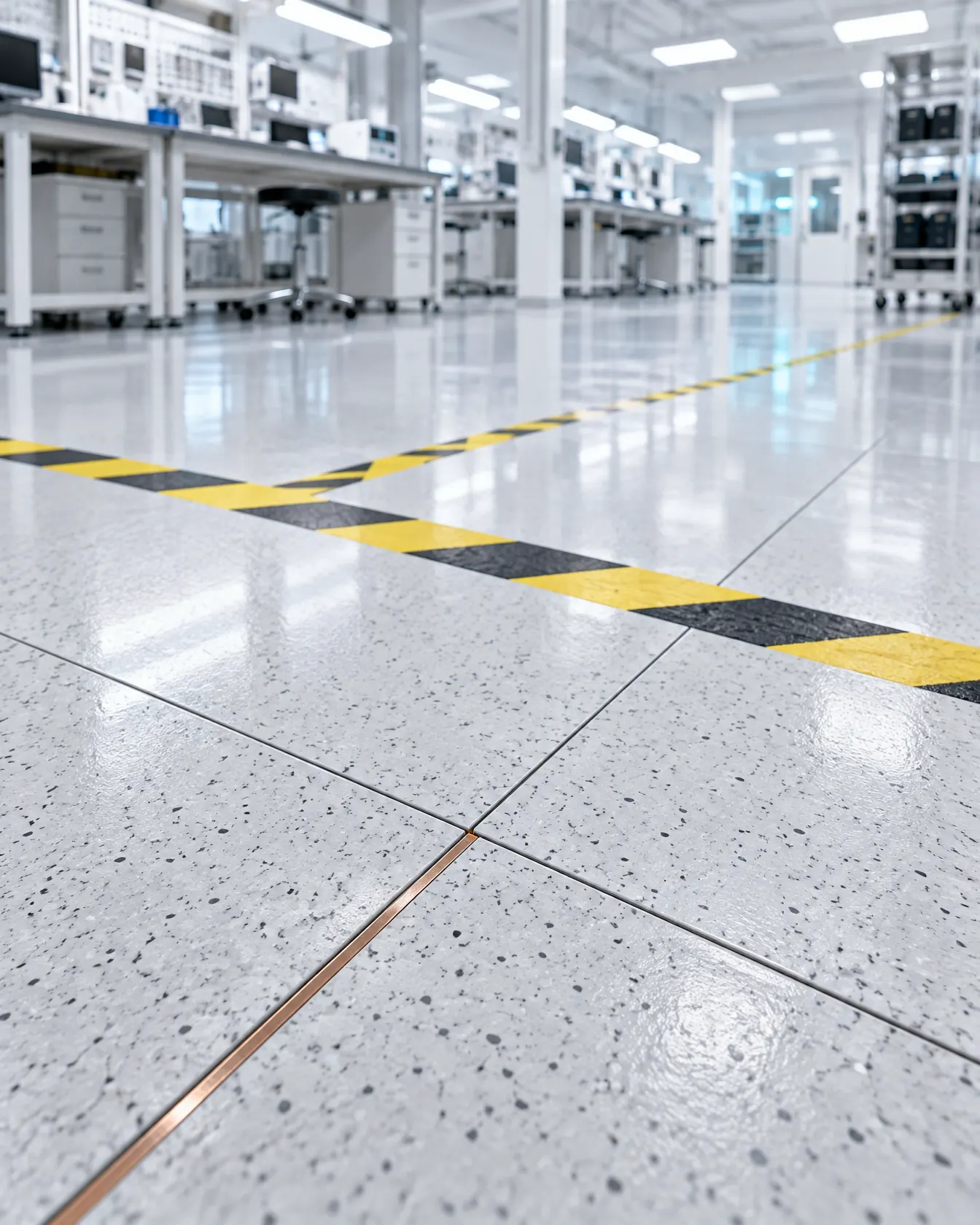
Field notes for static control.
Answers about ESD floors, the maintenance schedule that keeps them in spec, installation notes and product brochures to download.
Where does your reading sit?
Type a resistance from your meter. The ruler places it against tile classes, the S20.20 floor limit and the iDS-600 pass band, on a log scale from 10³ to 10¹¹ Ω.
—
Nine questions we're always asked.
From the Ace Star flooring team, who supply, install and repair HexStat and ESDWork floors.
What are ESD tiles, conductive tiles and static-dissipative tiles?+
An ESD tile is an ESD-safe floor tile for an ESD Protected Area (EPA) under ESD S20.20. There are two types: conductive and static dissipative.
What is the difference between conductive and static-dissipative tile?+
Both meet the S20.20 requirement for EPA floors of less than 1.0 × 10⁹ Ω. The difference is resistance. Conductive tile runs from 2.5 × 10⁴ to 1.0 × 10⁶ Ω. Most static-dissipative tile runs from 1.0 × 10⁶ to 1.0 × 10⁹ Ω, and some from 10⁶ to 10⁸ Ω.
Conductive tile has lower resistance and a more direct path to ground, so it controls ESD better.
Where should conductive tile be used, and where dissipative?+
You can never go wrong with conductive tile for ESD control. It has the lowest resistance, the best path to ground and the fastest decay time. Use it for IC manufacturing, semiconductor assembly and test, PCB/SMT and anywhere semi-finished electronics are exposed. Use it in explosive areas too, to prevent sparking.
Dissipative tile suits computer rooms, training areas, switching stations, finished-goods packing and pharmaceuticals, where no semi-finished parts are exposed. If the design team specifies conductive tile for a process, don't break the rule.
Isn't dissipative tile safer for people?+
That's a common belief. In fact conductive tile starts at 2.5 × 10⁴ Ω, not zero, which NFPA 99 and UL 779 accept as electrically safe flooring for people.
Millions of square feet of dissipative floor went down because of that misconception. The trend now is conductive tile, for better control of human-body voltage.
Is there a cost difference?+
No. With current tile manufacturing technology, conductive and static-dissipative tiles cost the same.
How do I ground my conductive or dissipative floor?+
Ground it to a known earth: either the earth of the main electrical service or a dedicated ESD ground proven to be well grounded. Keep all grounding systems (ESD ground, electrical ground, building earth) at equal potential, to prevent leakage current between grounding points.
Can a conductive floor protect technicians who don't wear ESD footwear?+
No. A conductive floor only works with ESD footwear (heel straps or ESD shoes) for personnel grounding. Technicians without ESD footwear can still handle sensitive parts safely if they wear a wrist strap.
If wrist straps are always worn, you can skip the conductive floor and save the cost. With a conductive floor plus ESD footwear, technicians can move around freely without being tied to a wrist-strap cord.
How do I maintain conductive or dissipative tiles?+
It's easy. Daily sweeping and damp mopping with clean water is enough for most applications. Wet mop weekly with a neutral detergent, and buff monthly or every two months to lift stubborn dirt.
Do the two tile types need different maintenance?+
No. Conductive and dissipative tiles follow the same maintenance procedure.
Keep resistance in spec.
The recommended routine. One rule overrides everything else: never apply normal wax.
Sweep, mop, spot-buff
- Sweep and/or dust-mop the entire floor.
- Wet or damp-mop soiled areas with neutral pure water.
- Remove scuffs and heel marks with spray buff.
Clean, rinse, dry-buff
- Sweep and/or dust-mop.
- Wet or damp-mop soiled areas with a neutral cleaner.
- Rinse the floor completely.
- Spray-buff scuffs, then dry-buff the entire floor. No normal wax.
Strip & restore
- Sweep and/or dust-mop.
- Strip the entire floor with a stripping solution.
- Rinse completely, spray-buff marks, then dry-buff. No normal wax.
- Keep tiles out of excessive heat such as direct sunlight.
A floor is only as good as what's under it.
Requirements for ESDWork conductive and dissipative tiles on concrete, ceramic or terrazzo. For wood, resilient floors, metal decks or anything else, ask us.
- Sub-floor clean, dry and free from dust, paint, oil, grease, asphalt, solvents, curing agent and old adhesive.
- Surface smooth and flat: a variation of 1/8" in 10 ft or better. Patch and level cracks and irregularities.
- Concrete properly cured, with moisture below 5% before installation.
- Ceramic tile solidly adhered. Remove loose tiles, then finish smooth once dry.
- Floor surface temperature must not exceed 30 °C during installation.
- Copper tape 15 mm wide × 0.025 mm thick, laid as a 6–10 m grid on the cleaned sub-floor.
- Copper tape extended about 600 mm up the wall or pillar to the ground/earth connection.
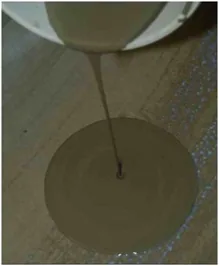
- Uneven sub-floor? Apply a 2–3 mm cementitious self-levelling compound: mix, pour, spread evenly, then spike-roll out trapped air.
Brochures & data sheets.
Product flyers from Ace Star and its partners, in PDF.